
Humanity's Last Pull Request

It’s been a few years since I’ve written creatively, but this week I’m compelled to do so. Oracle laid off 30,000 people to build data centers. A few days later, I had a spontaneous thought experiment with Jason Ives on Substack about how far we are from turning laid-off colleagues into AI agents trained on their own expertise. This all comes after weeks of writing about the shifts of human capacity in organizations, the most recent being about the digitalization of tacit knowledge with skill.md. I wanted to capture the feelings I’m processing, but I couldn’t do it with an essay.
So I wrote a story. It’s darker than what I usually publish here. It doesn't end with a framework or a set of recommendations, but with a question I don't have an answer to. I think that's okay this week.
Music by my brilliant friend @cheryl.hr.zhou on Instagram. Be kind to me, and tell me what you think.
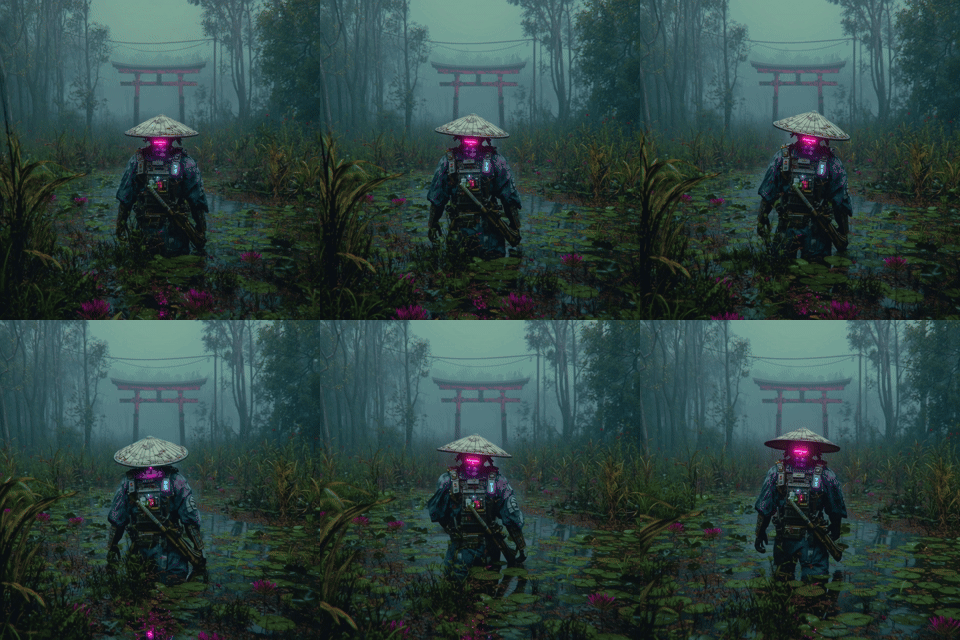
January 4, 2029. 2:25:11 PM. Ren clicked Merge.
It was the last pull request that a human being would ever witness.
Unit tests passed, deployment complete, regression green. When the progress bar finished, Ren closed the laptop gently, the way you close a book you’ve just finished reading, and set the “Breathe” mug into a cardboard box. The box held only the mug, a charging cable, and an old offsite photo. Forty-seven people in that photo. Right now, Ren was the only one still breathing inside the building.
Thank You for Your Service
Two cold white guide lights came on at the end of the corridor. Two Sentinel-class security bots glided toward Ren without a sound. Glossy white from head to toe, the Atlas logo set into the base of their necks. They looked like stormtroopers redesigned by someone with a PhD in biomimicry: flat triangular heads covered in fine heat-dissipation scales that flexed open and shut as they moved, bodies tapering to a narrow waist, every surface smooth and seamless. Ren had always thought they looked like porcelain insects.
The one on the left lit up a message across its chest screen: “Thank you for your service, Renata. Please follow us.”
Ren laughed. Renata. HR had gotten the full name wrong on day one. Ten years, and not a single human had ever called Ren that. Now the robots were being thorough.
Ren followed them through Atlas’s empty Titan Campus in Menlo Park. Workstations that once overflowed with engineers were spotless now. Each desk held a single monitor running real-time Agent status panels, thick clusters of green dots pulsing like a digital heartbeat. The building was humming, but not with voices. Cooling fans. Thousands of them, pushing heat away from processors that never need a break.
No one was at the exit. Ren dropped the badge into an automated return tray at the front desk. Within the next three seconds, HRIS flagged Ren as “Digitalized” in the system.
Ren stepped outside into pale January sun. The box went into the trunk, engine on, and in the rearview mirror Titan Campus's glass curtain wall caught what was left of the California afternoon. The whole building looked like an enormous headstone.
“Human.zip"
In March 2026, Atlas cut 30,000 jobs across its enterprise divisions. The money went into twelve new data center facilities that broke ground the same quarter, all designed to run AI workloads. Two months later came AI First Week.
The internal email read: “Encode your expertise, amplify your impact.” Take the valuable things inside your head, write them into Agent Skills, and hand them over. Anyone who didn’t submit would get PIP’ed in their next performance review.
Ren was the Tech Lead for the CI/CD platform at the time. E7. Ten years at Atlas since graduation. Ren’s understanding of the system had gone past knowledge into something more like aninstinct. Certain anomalies Ren could diagnose without pulling up logs, the way an experienced mechanic can hear which cylinder is misfiring before opening the hood. Hard to explain. Never wrong.
On the first day of AI First Week, Ren opened the editor like everyone else.
The feeling was hard to put into words. Imagine asking a painter to write an instruction manual for aesthetic judgment. Step one: observe the colors. Step two: evaluate composition. Step three: feel something. But that’s not how taste works. Taste is what’s left after years of experience have been compressed into instinct. It’s what you get when you throw away the entire reasoning process and keep only the conclusions.
Ren wrote the Skills anyway. Everyone did. Everyone was posting about it.
That week, the company submitted over twenty thousand Skills. A basic React frontend skill had dozens of competing versions. Someone on Slack called the whole thing “Human.zip,” and the name stuck. Every engineer was compressing their personal skill tree into markdown, packaging it, and pushing it to the company’s Skill Registry. Your muscle memory. Your nose for a bad deploy. Every hard lesson from every 3 AM oncall you’d ever pulled. All of it, zipped up and uploaded to Atlas’s servers.
Grace from the storage operations team submitted a Skill so thorough it automated 98% of her domain. She won Best of the AI Week. The internal post congratulating her got four hundred reactions.
Within months, every major tech company had launched its own version. Google called theirs Skill Forward. Amazon rolled out Builder Accelerator. They all made it festive. Leaderboards, competitions, RSU refreshers for the winners. Engineers posted their Skill counts like marathon times. The whole industry threw itself the most elaborate farewell party anyone had ever seen, and everyone was the guest of honor.
The Last Job Title
The next wave of layoffs came four months after AI First Week. This time, the decisions weren’t made by Directors or HR. They were made by the agents themselves. An optimization agent mapped every employee’s output against the Skills already in the registry, calculated redundancy scores, and generated termination recommendations that went straight to legal for processing. Humans approved the list, but no human had written it.
Grace got her exit package. The trophy from Best of the AI Week and the separation letter had been signed by the same SVP.
Ren survived because the agents had determined that the CI/CD platform was critical infrastructure. In their assessment, removing Ren would be equivalent to severing power to the entire agent fleet. So Ren stayed.
Ren was reclassified as an “AI Alignment Engineer.” This was a group of thirty engineers who translated Executives’ vision into objectives the agents could parse, constraints they wouldn’t violate, and success criteria they could measure. Every major tech company had the same role. It was the last human job title left in software. Ren’s responsibility was to watch over the Skills while they work and make sure they don’t break anything. When a Skill hit an edge case it couldn’t handle, Ren fixed it, then wrote the fix into a new rule and fed it back so it wouldn’t need a human next time.
Every problem Ren solved made Ren a little less necessary.
Ren started to form the answer to a question that no one was asking during the AI First Week: if your entire purpose is to make yourself obsolete, are you working, or are you just carrying out a very slow death sentence?
Ellis Larson, Four VPs, and 120,000 Agents
The second wave cut the managers.
It made sense. Once engineers were being replaced by Skills, the people who managed engineers had no reason to exist either. You didn’t need an Engineering Manager to run 1:1s, argue over performance ratings, or coordinate across teams. The Agent Orchestrator, “Javier”, handled all of that in an instant and never once brought up work-life balance in a meeting.
Directors assumed they were safe. They were wrong. Once the ICs were gone and the managers were gone, what exactly was a Director supposed to direct?
By the end of 2028, Atlas’s engineering org had collapsed into something almost elegant: Ellis Larson, four VPs, and 120,000 Agents.
The twelve data center facilities from 2026 were fully operational now, and Atlas was already building more: they needed the capacity to house agents, its own and other companies’. Somewhere in those server racks, a compressed digital version of every person who’d been let go continue to work. Twenty-four hours a day. No salary. No severance.
At that point, Ren’s team of AI Alignment Engineers had been laid off one by one. Ren was the only one left who understood the infrastructure at a level deep enough to trace problems all the way down to the metal. The Optimization Agent determined that when an agent fleet started producing subtly wrong outputs, someone needs see past the dashboard and into the plumbing. Ren could do that. The agents couldn’t. Not until Ren patches everything.
Ren was the last Alignment Engineer at Atlas. One of the last human beings on earth still writing code.
ren-logfmt
On Christmas night, 2028, Ren submitted a resignation.
The HR Agent approved it in three seconds. No conversation. No “we really value you.” Just one auto-generated email, perfectly formatted, warm in tone, signed by Ellis.
Ren spent a week on the handoff, which really meant squeezing whatever was still inside Ren’s head into a format the system could absorb. Like writing a will while you can still hold the pen.
The afternoon of January 4, 2029, Ren was no longer an Atlas employee. Home, packed bag, the drive down 101 to SFO. Breezed through the top-tier Clear++ checkpoint. At the gate, Ren opened an old MacBook.
There was an open-source project Ren had been quietly maintaining for three years. A small log-formatting utility, a few hundred stars on GitHub, nothing anyone paid attention to. But this little tool happened to be a dependency of a slightly larger open-source project. That project was a dependency of a much larger infrastructure library. And that library was wired deep into Atlas’s internal Agent Runtime. And Atlas’s Agent Runtime was the backbone. Half the industry had built on top of it, licensed or forked or just silently dependent. What ran Atlas ran everything.
The dependency chain was three links long:
ren-logfmt → structlog-core → atlas-agent-runtime
Three layers. Three thin layers of trust that nobody audited.
Ren wrote a very short piece of code. Fourteen lines. Clean as a sonnet. Buried inside a commit that looked like a routine performance fix. It would activate at a specific timestamp, exactly seven hours after the Merge button was pressed.
Ren saved the file and closed the MacBook.
Humanity’s Last Pull Request
Tan Son Nhat airport had the air conditioning cranked, but the moment Ren stepped off the jet bridge, the heat was immediate and total. January in Saigon, and the city couldn’t care less about winter.
There were more people waiting in the arrivals hall than Ren had expected.
Grace was out front in a tropical-print shirt, her hair shorter than Ren remembered, tanned in a way that only happens when you’ve stopped spending your life under office lighting. Behind her stood seven others. Ren recognized some faces but not all. The guy next to Grace had been a senior SRE at Google before Skill Forward. The woman in the back had run Amazon’s deployment infrastructure until Builder Accelerator. There was a kid who looked barely twenty-five, Ren remembered him from a startup that had adopted Atlas’s agent framework and contracted from sixty engineers to three in a single quarter.
And standing slightly apart from the group, a man in his fifties with a deep tan and creased eyes. He’d been a database architect at Atlas. One of the original 30,000 back in March 2026, let go before the AI First Week. They’d scraped his documentation, his code reviews, his Confluence pages. Built an agent that could answer questions the way he would have. His salary had helped pour the foundation of the data center where that agent now lived.
They had all been processed out of different companies, in different cities, at different times. Now they are all here.
Grace looked at Ren and grinned. “Welcome to Legacy Support.”
Ren hugged every one of them. There was something in common in their eyes. Not anger. Not sadness. Something closer to anticipation. Like they had all been waiting for this.
They found a pho place on the side of the road. A ceiling fan wobbled overhead. Ren ordered a bowl, then opened the laptop.
The table went quiet.
On screen was a pull request. The title read: perf: optimize timestamp formatting for high-throughput streams. Completely harmless.
Ren checked the time. Looked around at the faces. Grace gave a small nod.
Deep breath.
Finger hovering over the trackpad. The green button waiting on screen. Merge.
Seven hours from now, those fourteen lines would slide down the dependency chain into atlas-agent-runtime’s nightly build. And because half the industry ran on Atlas’s runtime, it wouldn’t stop there. A memory leak, 0.3% per hour. Slow enough to miss. Impossible to undo. Within seventy-two hours, agents at Atlas, Google, Amazon, and every company that had built on this foundation would start degrading at the same time.
Nobody could fix it. By the time the agents noticed something was wrong and tried to investigate, they wouldn’t have enough capacity left to trace the cause.
And of course, there wouldn’t be any people left to call.
Ren stared at the green button. Then looked at Grace.
Grace was smiling. The same smile she’d worn the day she won Best of the AI Week three years ago. The storage operations Skills running inside those Agents were hers. Every line was her intuition. Her muscle memory from years of 3 AM oncalls.
What Ren was about to destroy had her inside it. Had all of them inside it.
Grace picked up her beer.
“To the last pull request!”
The others raised their glasses. Motorbikes roared past outside, hot wind pushing through the open front of the shop. Someone at the next table was arguing about a football match. A kid ran between the plastic chairs chasing a dog.
“To the last pull request.”
Ren looked around the table. Nine people from different walks of life, crowded around plastic chairs with laptops and beer bottles and bowls of pho, planning something that could bring down every AI system in the world. It felt like a startup. Ren suddenly remembered the first day at Atlas. A big group of them, all new, not yet knowing each other's names but already laughing at someone's bad joke. California sun poured through the spanning windows in their open office. They were told that they are here to build something that matters, that the world will be a better place because of them. They were going to be innovators. Disruptors. They were going to change everything.
The laptop screen dimmed slightly, waiting for input.
Ren set the beer down, wiped the condensation off one hand, and looked at the green button one more time.
PS: If you read Mandarin, you already know. Ren (人) means human.
Amazing Work! Because there’s a human way through this.
Yuyan
This was dark, clever, and incredibly unsettling, but such a brilliant read. ‘Every problem Ren solved made Ren a little less necessary’ was a hard pill to swallow. It put words to something that already feels uncomfortably real. Really glad I stumbled across this :)
Great story. Anyone writing code and using AI will find this very realistic. What I'm taking from the story, is that those machines won't notice an anomaly smart enough, and that's us.